Mentoring
SFB 1451 Motor Control in Health and Disease
©bestber; Shutterstock
Mentoring is on-the-job training: Mentees develop their personal skills on the basis of specific professional questions and topics. For this, mentors draw from their professional and life experience to teach mentees, for example, which behaviour in meetings is appropriate and promising, or which personal abilities can be developed more purposefully to achieve specific career goals. Both sides benefit from this relationship, as in interacting with the mentee, mentors gain new perspectives as well, as reflection on their own career is encouraged and leadership and communication skills are strengthened.
The Offer of Human Resources (HR) Development for Researchers can be found here. For more information, please visit the Mentoring Page of the University of Cologne
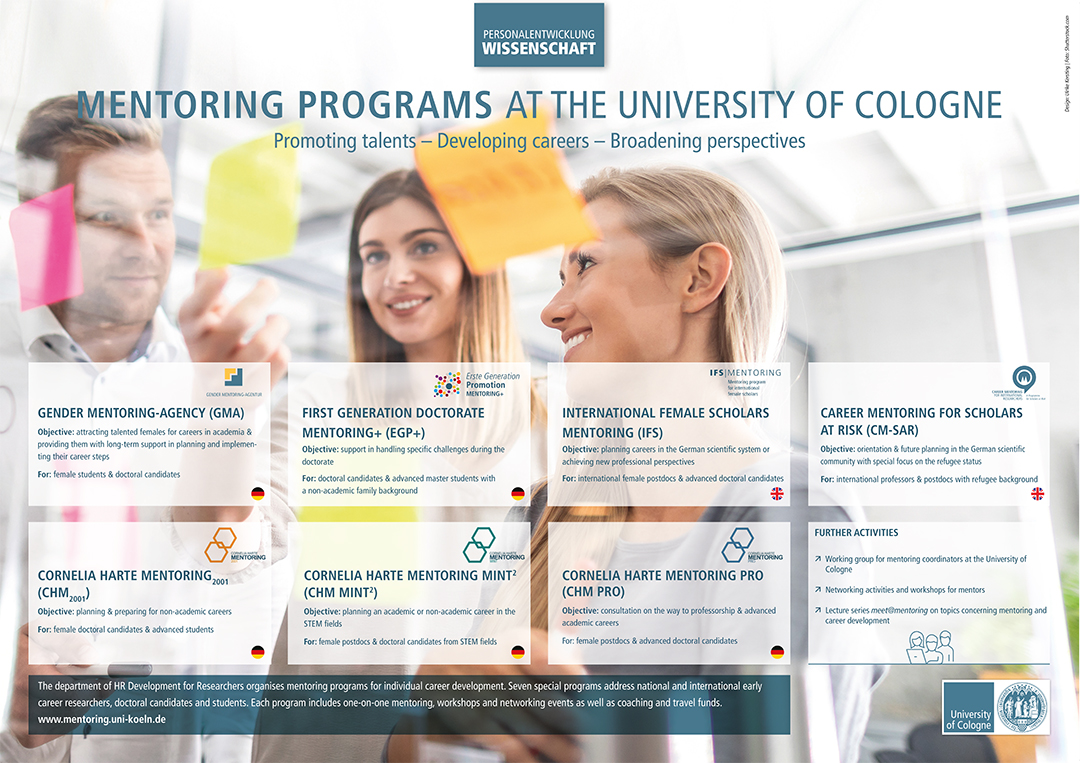
Some examples you can find here:
First Generation Doctorate Mentoring+
The program First Generation Doctorate Mentoring+ is a unique mentoring program in Germany for doctoral candidates and advanced master students with a non-academic family background. Participants are accompanied for one year by a doctorate mentor who shares the non-academic background. The mentors support their mentees in the planning and execution of their doctorates. Against the background of shared experience, the mentoring tandem discusses questions and problems relating to doctoral studies, dealing with feelings of alienation or career development. In addition to the one-to-one mentoring, the programme also includes workshops tailored to the needs of the target group. First Generation Doctorate Mentoring+ is aimed at doctoral candidates and advanced master students of all sexes and all faculties of the University of Cologne. The workshops are held in German. The mentoring can be conducted in German or English.
Gender Mentoring Agency (GMA)
In the Gender Mentoring Agency (GMA), we offer participants a program for planning and developing careers in science. In doing so, we accompany them in transitional phases, from bachelor/master studies to doctorate and into the postdoc phase. You can participate in the Gender Mentoring Agency if you are a student or doctoral candidate at the University of Cologne and plan to work in science after completing your doctorate. In addition to individual contact with professionally experienced mentors, the Gender Mentoring Agency program includes continuing education opportunities, networking meetings, and conference scholarships. After registering for the GMA, you will go through a one-year structured program. Afterwards you can continue to benefit from the open offers (including networking events, conference scholarships, continuing education) throughout your bachelor/master and doctoral studies. The GMA is a fee-free offer of the Department for Human Resources Development and aims at female doctoral candidates and female students of all faculties.
Cornelia Harte Mentoring
TheCHM Programmes combine one-on-one mentoring with general skills training and networking and are tailored to different target groups. The main objectives of these programmes are the dissemination of life and work experience and the setting up of networks between mentors and mentees. In particular, CHM-MINT supports graduate students and post-docs in their scientific career path within the natural sciences, by organising networking events and providing specific training.
Female Career Program (FCP), University of Cologne
The Female Career Program (FCP) provides regular training courses in vital areas such as networking, presentation, interview technique, project management, leadership skills etc. aimed at female students, graduate students as well as academic staff. In addition, the FCP offers support and advice during all stages of career development with a special programme for women in mathematics and natural sciences.
First Generation Doctorate Mentoring+
The program First Generation Doctorate Mentoring+ is a unique mentoring program in Germany for doctoral candidates and advanced master students with a non-academic family background. Participants are accompanied for one year by a doctorate mentor who shares the non-academic background. The mentors support their mentees in the planning and execution of their doctorates. Against the background of shared experience, the mentoring tandem discusses questions and problems relating to doctoral studies, dealing with feelings of alienation or career development. In addition to the one-to-one mentoring, the programme also includes workshops tailored to the needs of the target group. First Generation Doctorate Mentoring+ is aimed at doctoral candidates and advanced master students of all sexes and all faculties of the University of Cologne. The workshops are held in German. The mentoring can be conducted in German or English.
MINT Mentoring
The STEM (Science, Technology, Engineering & Mathematics) mentoring (german: MINT-Mentoring) supports female scientists in their personal and professional career planning. The program is aimed at female doctoral students, postdocs and research assistants in the Faculty of Mathematics and Natural Sciences at the University of Cologne. The goal of STEM mentoring is to support female scientists in their professional and personal orientation, planning and development. The modules of one-on-one mentoring, networking and training as well as individual coaching enable them to get to know and reflect on career paths within research or science management as well as outside the university in industry and business and to connect them with their own potential.
Gender Mentoring Agency
In the Gender Mentoring Agency (GMA), we offer participants a program for planning and developing careers in science. In doing so, we accompany them in transitional phases, from bachelor/master studies to doctorate and into the postdoc phase. You can participate in the Gender Mentoring Agency if you are a student or doctoral candidate at the University of Cologne and plan to work in science after completing your doctorate. In addition to individual contact with professionally experienced mentors, the Gender Mentoring Agency program includes continuing education opportunities, networking meetings, and conference scholarships. After registering for the GMA, you will go through a one-year structured program. Afterwards you can continue to benefit from the open offers (including networking events, conference scholarships, continuing education) throughout your bachelor/master and doctoral studies. The GMA is a fee-free offer of the Department for Human Resources Development and aims at female doctoral candidates and female students of all faculties.
Cornelia harte Mentoring (CHM)
The CHM Programmes combine one-on-one mentoring with general skills training and networking and are tailored to different target groups. The main objectives of these programmes are the dissemination of life and work experience and the setting up of networks between mentors and mentees. In particular, CHM-MINT supports graduate students and post-docs in their scientific career path within the natural sciences, by organising networking events and providing specific training.
IFS Mentoring Program
The IFS Mentoring Program is designed especially for female academics from abroad. This program matches PhD students and postdoctoral fellows with experienced professors in one-on-one mentoring relationships. The program is accompanied by a variety of workshops and individual coaching sessions. The framework program as well as the one-on-one mentoring takes place in English.
Female Professors Program
The management program consist of seminars on leadership, time management, delegation, professional appearance, communication and conflict management. Significant components of this development process are the technical guidance from experienced trainers, intensive group work and feedback sessions as well as the personal and professional exchange among the participants.